3 Diverse Giving Opportunities To Enhance The Donor Journey

This article was provided by FreeWill.
Traditional cash and credit card donations can limit your donors, especially when major life milestones—such as retiring or selling a home—realign their financial priorities. When nonprofits expand their giving channels to include a variety of options, they allow donors to contribute in ways that lower their personal tax burdens and align with their preferences.
Flexibility shifts supporters away from routine giving and refocuses them on becoming strategic, long-term philanthropic partners. Plus, offering these diverse donation methods creates revenue streams that protect your mission against broader economic shifts.
As your organization promotes these new giving channels across state lines, remember to stay up to date with charitable solicitations registration, so you can maintain full legal compliance while reinforcing donor confidence in your stewardship. With that in mind, let’s dive into our first recommended donation method.
Legacy giving connects a supporter’s personal life story to your organization’s future impact. By blending estate planning options into regular fundraising channels, your nonprofit can empower supporters to extend their impact far beyond their immediate financial capacity.
For context, “legacy giving” refers to donations designated in estate plans that take effect either during or after a donor’s lifetime. Bequests serve as the most accessible form of planned giving, requiring no immediate cash outlay.
FreeWill’s planned giving guide outlines these core benefits to showcase why nonprofits focus on this giving method:
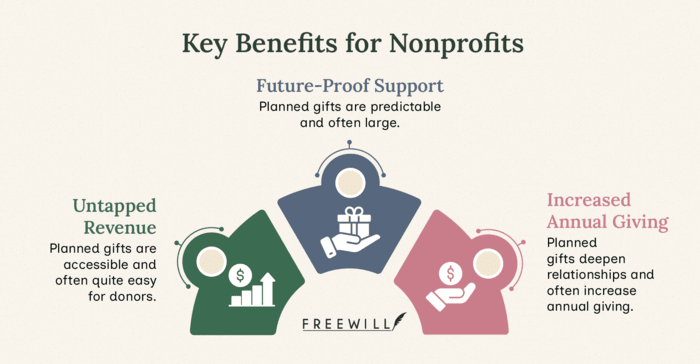
- Accessibility for donors across all tiers: Donors can commit to a future gift without altering their current cash flow or compromising retirement security, removing financial barriers for loyal supporters of all capacities.
- Predictable, future-proof funding: Legacy gifts provide long-term support that buffers organizations against economic volatility.
- Higher lifetime giving velocity: Promising a bequest deepens donor commitment now, often driving increased annual contributions during their lifetime.
Demystifying estate planning concepts in donor communications helps normalize bequest conversations. To spread awareness, start by creating educational resources like planned giving brochures and a microsite. For context, a microsite is a standalone website that functions separately from your organization’s main website and is ideal for major fundraising initiatives, like your planned giving program. It gives supporters a comfortable space to explore their legacy giving options and is a great spot to feature any tools you offer, such as free will creation tools.
Essentially, educational resources will lower entry barriers and help donors discuss their goals with advisors. To protect these future commitments and prevent the misappropriation of nonprofit funds, be sure to also maintain strict financial oversight. For instance, a donor may designate their gift to support a specific program, so you need to honor those wishes through effective gift tracking.
Stock giving involves transferring appreciated assets—such as stocks, bonds, or mutual funds—directly to a nonprofit. Direct transfers eliminate capital gains tax for the donor while allowing them to claim a full fair-market-value income tax deduction for assets held longer than one year.
Accepting gifts of stock elevates donor relationships by positioning your nonprofit as a sophisticated partner in a supporter’s broader wealth management goals. By moving beyond traditional cash requests, your organization can unlock major contributions from non-cash wealth that both existing and new donors might not realize they can leverage for impact.
To maximize this opportunity, streamline the donation process by placing step-by-step instructions and brokerage transfer details on your “Ways to Give” page. Making this information easy to find empowers both donors and their financial advisors to complete transfers smoothly. To manage risk, leverage an automated platform to liquidate gifted securities immediately upon receipt, protecting your organization from market fluctuations.
When nonprofits fail to adapt to modern giving methods like crypto, they miss out on connecting with younger donors. According to BWF’s guide to donor engagement, nonprofits should put a special emphasis on next-generation donors, because they’ll inherit trillions of dollars and allocate nearly half to charity. These younger donors want to revolutionize philanthropy to make it more effective, so they’re more strategic in their giving. Crypto is a great way to tap into this.
Built on blockchain technology, cryptocurrency appeals directly to digitally native donors looking for modern ways to make an impact. Plus, direct crypto gifts offer substantial tax advantages to donors, because the IRS classifies cryptocurrency as property rather than currency. Donating appreciated tokens held for over a year eliminates capital gains taxes while unlocking a full fair-market-value tax deduction.
Consider a supporter who purchased $10,000 in crypto over a year ago that is now worth $35,000 ($25,000 in capital gains). They have two options for donating these funds:
- Sell the crypto and donate post-tax cash: If they sell the crypto holding first, they’ll pay a 20% capital gains tax on the $25,000 gain, which totals $5,000. They would then donate the remaining $30,000 in cash to your nonprofit, claiming a $30,000 tax deduction.
- Donate the crypto directly: The donor transfers the crypto directly to your organization, paying $0 in capital gains tax. Your nonprofit receives the full $35,000, and the donor may claim a federal tax deduction for the entire $35,000.
To start accepting crypto safely, choose an established crypto processing platform that accepts a variety of cryptocurrencies and features automated liquidation. These tools immediately convert volatile digital tokens into USD, eliminating market risk, administrative burdens, and wallet security concerns. Additionally, make sure your platform automatically generates tax receipts to simplify compliance for your donors.
Diversifying giving channels honors donor intent and unlocks untapped financial capacity at every stage of the supporter journey. Aim to meet donors where they are in their financial lives, so you can transform routine givers into lifelong strategic partners.
To expand your giving opportunities, audit your current methods and select one new option to incorporate. Publish step-by-step instructions alongside your legal name, EIN, and organizational contact details. Maintaining an active 501(c)(3) status and displaying your tax information will reassure both donors and their financial advisors that complex, high-impact gifts will qualify for full tax benefits.
Expanding your options doesn’t require an overhaul of your entire fundraising program—just a commitment to removing friction for your supporters’ generosity!
who subscribe to our free, email newsletter. It’s information that will empower your nonprofit!

Comments (0)