
Your Q4 Fundraising Check-In: Five Things to Review Before Year-End

With year-end approaching, most nonprofits are already into the biggest fundraising stretch of the year. For many organizations, a large share of annual giving arrives in the final weeks of December, so a year-end plan that amounts to “we’ll figure it out in December” leaves an awful lot riding on very little.
A Q4 fundraising check-in is a structured review of where your giving actually stands against your goal, followed by the adjustments needed to close the gap before December 31. It covers five areas: your real year-to-date numbers, your appeal calendar, your donor acknowledgment paperwork, your existing donors, and the rules that decide which tax year a gift lands in.
Plans drift over the course of a year. A grant falls through, a board member loses track of a commitment, or summer simply gets away from everybody, and suddenly the plan from January no longer matches reality. That’s a normal part of running an organization, and we see it constantly; what you do about it in the next few weeks is what determines how the year turns out.
The first step in any Q4 fundraising check-in is pulling your actual year-to-date giving total and comparing it against your real operating goal, meaning the number your budget depends on. Your stretch goal (and the figure that made the board feel good back in January) can be great for motivation, but it’s the wrong benchmark for a mid-course correction. You’d be amazed how many organizations we work with are running on a gut feeling here instead of a number.
When you pull that total, keep gifts you’ve actually received separate from pledges. Nonprofit accounting standards generally record an unconditional pledge as revenue when it’s made, but a promise won’t cover December’s expenses, and tracking the two separately now makes your year-end books, and eventually your Form 990, far easier to finish.
If you’re sitting at about 60 percent of goal with about two months left, that’s workable, though it calls for a specific plan with dates and owners attached. At 35 percent, the conversation shifts toward what’s realistic for the remaining weeks and what adjustments the rest of your budget may need. You can’t course correct a number you haven’t actually looked at.
We understand why this step gets skipped. Many of the people running nonprofits are what we call right-brain entrepreneurs: mission-first, heart-led, and deeply passionate about the work. A spreadsheet full of numbers that might disappoint you is nobody’s favorite Tuesday afternoon. Avoiding it only delays the news, though; you find out in January instead of October, and by then your options are a whole lot narrower. Rather than waiting for urgency to force the review, put a recurring monthly reminder on the calendar and make it a habit starting this week.
Successful year-end campaigns usually run as a planned sequence of four touches between early November and December 31, each with a date on the calendar and a named owner responsible for it. If those dates aren’t blocked out yet, this is the week to do it.
Each touch in the sequence does a different job:
- Early November ask. This gets you on donors’ radar before their inboxes turn into a demolition derby in December.
- Giving Tuesday (December 1, 2026). This push builds momentum and taps into the giving energy that’s already in the air that week.
- Mid-December impact story. This reminds supporters why they cared in the first place by showing what a gift makes possible, rather than simply asking again.
- Final ask in the last days of December. This is your most direct appeal, and it works because a meaningful share of giving, for better or worse, happens under deadline pressure.
Skip one of these touches and you lose the specific job that message was supposed to do. The November ask can’t build Giving Tuesday momentum, and the December 30 ask can’t tell your impact story with any depth.
Donor acknowledgment paperwork is the item people forget until it becomes a crisis, so get your templates ready before the December rush. Two IRS rules drive most of this work.
Written acknowledgment for gifts of $250 or more. Under Internal Revenue Code Section 170(f)(8), a donor can’t deduct a single contribution of $250 or more without a contemporaneous written acknowledgment from the charity. The acknowledgment must state the amount of cash given (or describe any noncash property), say whether your organization provided any goods or services in return, and give a good-faith estimate of their value if it did. “Contemporaneous” means the donor has the letter in hand by the earlier of the date they file their return or the return’s due date, including extensions.
Quid pro quo disclosure for payments over $75. Under Section 6115, when a donor pays more than $75 and receives something of value back (a gala dinner, an auction item, or event tickets), your organization must provide a written statement explaining that only the amount above the value of what they received is deductible, along with a good-faith estimate of that value. The penalty for skipping it is $10 per contribution, up to $5,000 per fundraising event or mailing. The IRS lays out both rules in Publication 1771, which is accurate but not exactly a page-turner. In plain English: if someone gives you money and gets something back, even partially, you have to tell them in writing what that something is worth so they know how much is actually deductible.
We seem to harp on documentation a lot around here, and this is why. Trying to reconstruct two hundred acknowledgment letters in the first week of January is nobody’s idea of a good time.
Retaining an existing donor is dramatically cheaper and more reliable than acquiring a new one, which makes your current supporters the highest return part of any fundraising plan. Q4 tends to feel like a hunt for new money, and that instinct pulls attention away from the people already giving. Your monthly recurring donors, multi-year major donors, and the folks who’ve given every December for the last five years deserve a thank-you and a check-in before they get another ask.
Give your existing donors time, attention, and gratitude before you spend all your energy chasing people who’ve never heard of you. A phone call or handwritten note to your top 10 or 20 donors takes an afternoon and costs nothing but time. Showing up for the people who are already with you, before asking them for anything else, is simply good stewardship, and it tends to make the December ask land better too.
While you’re reaching out, take a few minutes to clean up each donor’s record: current contact information, complete giving history, and any restrictions a donor placed on how a gift can be used. Your organization is obligated to honor those restrictions, and accurate records make the year-end acknowledgment push much faster. They also matter at filing time, since organizations that file the full Form 990 or Form 990-EZ generally report contributors who gave $5,000 or more during the year on Schedule B.
A gift counts in the tax year it’s delivered to the charity, and what “delivered” means depends on how the money moves. A mailed check generally counts on the date it was mailed (the postmark is the usual evidence), a credit card gift counts when the charge goes through, and a stock gift counts when the shares actually arrive in your organization’s account. The calendar is less forgiving than most people assume, and one of these rules picked up an important wrinkle in the last year.
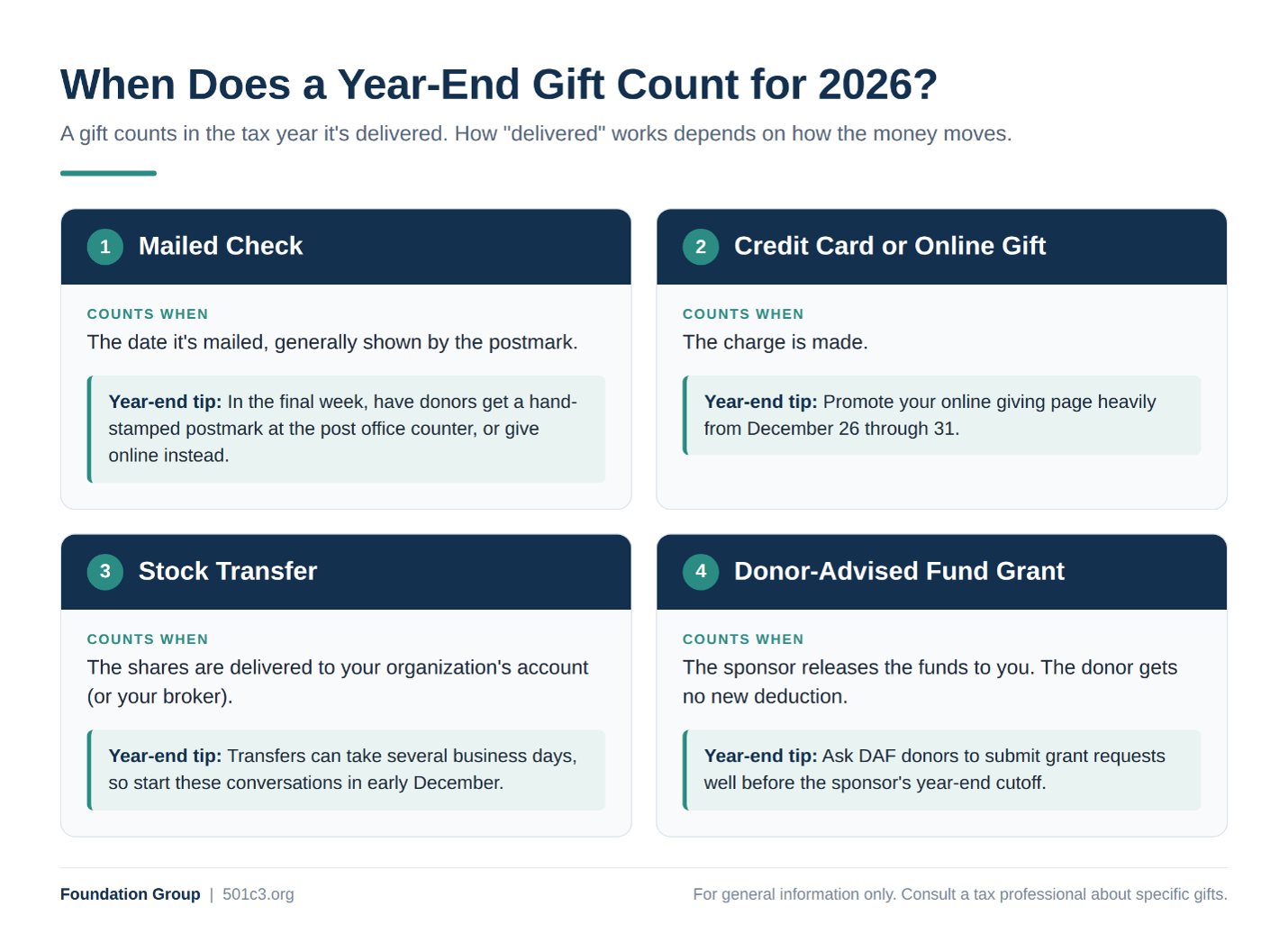
Effective December 24, 2025, the U.S. Postal Service updated its Domestic Mail Manual to clarify that a machine-applied postmark reflects the date of the first automated processing at a USPS facility, which can be later than the date the mail was dropped off. Because so much mail now travels to a regional processing center before it’s stamped, a check dropped in a mailbox on December 31 could come back postmarked in January. That can push the donor’s deduction into the wrong tax year without either of you realizing it, and year-end 2026 is the first full giving season under the clarified rule.
For anything mailed in the final week of December, an ordinary postmark is no longer a safe bet. Donors can ask for a manual (hand-stamped) postmark at any post office counter at no extra charge, or purchase a Certificate of Mailing (PS Form 3817) as proof of the mailing date. USPS has also noted that pre-printed postage labels show only when postage was purchased and don’t count as a postmark. The simplest fix is pointing late-December donors to your online giving page, where the timestamp is instant.
Stock transfers and donor-advised fund (DAF) grants both depend on someone else’s processing timeline. For a stock gift, the deduction date is when the shares are actually delivered to your organization’s account, which has nothing to do with when the donor told you they’d make the gift. Brokerage transfers can take several business days, and those days get longer in late December.
DAF grants work differently. The donor already took the tax deduction when they contributed to their donor-advised fund, so a grant from that fund to your organization isn’t deductible a second time. Your acknowledgment letter shouldn’t suggest that it is. Timing still matters for your own year-end totals, though, because the grant only lands when the sponsoring organization releases it, and many sponsors set their own December cutoffs. If a major donor is talking about a stock gift or a DAF grant, have that conversation now rather than on December 29.
Your five-point Q4 fundraising check-in comes down to knowing your real number, building the appeal calendar, getting acknowledgment paperwork ahead of the rush, caring for the donors you already have, and understanding the timing rules before the clock runs out. None of it is complicated, but all of it is easy to let slide when you’re running a small nonprofit with about four people wearing twelve hats between them.
We talk a lot about taking a decades-long view of your organization, and every one of those decades is built out of years that get decided in moments like this one. You still have time to adjust the plan while there’s runway left, so go pull your numbers this week.
If you get into December and find that your books, receipts, or compliance paperwork need cleanup, our Foundation Group Accounting Services and SureComply™ teams handle exactly that work, and we’ve been helping nonprofits do it since 1995, more than 50,000 of them so far.
who subscribe to our free, email newsletter. It’s information that will empower your nonprofit!

Comments (0)